
I was recently sharing ideas with a close friend of mine who owns a marketing agency about the importance of developing a sales process. In doing so, I was naturally walking him through how I do sales and what is working well for me. His response was, “I hope you are documenting this framework; you are onto something.”
Like many entrepreneurs, I wasn’t consciously trying to develop a framework—I was simply in the mindset of ‘just doing.’ Getting on with things and experimenting to see what works best and what I am learning to help improve my sales process. This guide is my attempt at articulating my Service Based Sales Framework.
I designed this guide with independent consultants, freelancers and small agency owners in mind. Typically, this audience sells high-value services to medium-sized and large businesses. This is not suited for digital-first products such as selling ebooks or online courses.
Why Service Based Sales?
As an entrepreneur, the majority of my experiences building my own businesses have been in the service space. Put simply, it means that I sell my services rather than selling a product. My current business sells human-centred leadership development consulting services, ranging from designing and delivering programmes to facilitating a full day of connecting through conversations with leadership teams.
I sell myself primarily, and depending on the scale of work required, I also sell a small number of facilitators to deliver programmes I have designed alongside me. Before this business, I ran The Angel Investing School. Again, this was a service-based business where I ran online cohort-based courses to train people from all backgrounds how to get started with investing in startups.
In the last five years of running these two businesses, I have learned what works, what doesn’t and what I still need to do better. One of my main learnings is that as an entrepreneur, you have to get great at selling before hiring someone else to sell for you. The two reasons for this are that:
- No one will be as passionate and knowledgeable about your business as you, so you are the best person to sell what you love doing.
- It enables you to create a process (framework/ playbook) to make it easier to onboard a salesperson, and eventually, it also makes it easier to sell your business.
The Service-Based Sales framework is designed for the cash-strapped entrepreneur, so I intentionally focus on organic, free methods to drive sales rather than paid advertising.
The Differences in Software Sales
I must confess, I am no expert at software sales, and I have never worked in the role throughout my career. However, I have worked with people in the role for many years and observed some differences in what they do versus what I do in selling my services.
1. Product vs. People
When you sell software, you’re selling a digital product, something tangible, with defined features, pricing, and usually a clear demo or trial. The value is in what the software does, how it automates, scales, or solves a problem.
You can walk through a similar sales process, but selling software is slightly different from selling people. For example, I could give you a free trial of a software for 14 days. I wouldn’t work for free as a person for 14 days with a client.
When you sell consulting services, you’re selling people’s expertise, time, and problem-solving ability. The “product” is less tangible and more variable, often tailored to each client’s needs. It is like having a box of LEGO bricks you know well and can assemble in many different ways. The value is in the people, their skills, and their ability to deliver outcomes.
2. Sales Cycle and Buying Triggers
Software sales often have a more standardised sales cycle. Buyers are looking for a solution to a specific problem, and the process can be demo-driven, with clear onboarding and support. The decision is often about features, price, and fit.
Consulting sales are more relationship-driven and can have a longer, less predictable sales cycle. Buyers are often looking for trust, credibility, and a partner who understands their unique challenges. The process is more consultative, with lots of discovery and customisation.
On the flip side, if you have a strong relationship with someone who can influence the buyer, the sales process can be a matter of days or weeks. For example, I delivered several pieces of work for a multinational, but my primary relationship was with Miss N. Miss N then moved to a new multinational client, and we stayed in touch. When the opportunity arose, she positioned me well with her boss for a team day workshop I delivered. She sold me on the strength of her relationship with her boss and me, and it took less than two weeks. We will touch more on this process called ‘nearbounding’ later.
3. Scalability and Delivery
Software is highly scalable; once built, you can sell it to many customers with little incremental cost. Delivery is automated, and support is often standardised.
Consulting is not easily scalable; each new project requires more people, and delivery is manual. Quality and outcomes depend heavily on the individuals involved, and there’s a limit to how much you can grow without hiring more talent.
One of the biggest risks with scaling is your hard-earned reputation as more and more people are delivering on your behalf (your brand name). This can be a hard shift for many entrepreneurs as they scale beyond their capacity and balance working on the business, not just in it. The E-Myth is a great book on this topic, and my previous post Auditing Your Time covers this topic.
Introducing Service Based Sales

Service Based Sales require a thoughtful approach, as you’re not just selling a product, you’re offering expertise, trust, and partnership. There are several proven methods to connect with your ideal clients. In this guide, I’ll break down each method, explain how it works, and share real examples from my own experience.
The four key low-cost (or free) methods I will share in this guide are:
- Inbounding: Attracting prospects who find you and enquire about your services based on valuable content.
- Nearbounding: Leveraging existing relationships for introductions.
- Crowdbounding: Engaging with a curated group of ideal prospects at targeted gatherings.
- Outbounding: Proactively reaching out to prospects who may not know you yet.
| Feature | Inbounding | Nearbounding | Crowdbounding | Outbounding |
|---|---|---|---|---|
| Initiation | Prospect initiates | Mutual connection | You initiate via targeted gatherings | You initiate directly |
| Relationship | New, self-selected | Warm, existing | Curated, event-based | Cold, often unknown |
| Channel | Content, SEO, social (Linkedin) | Referrals/ intros, partnerships | Events (roundtables, webinars, seminars) | Cold calls, emails and DMs |
| Trust Level | Built over time | High (pre-established) | Medium-High (authority at event) | Low (must be earned) |
| Targeting | Broad, interest-based | Highly targeted (network-based) | Highly targeted (ICP at events) | Variable, can be broad or narrow |
| Speed | Slower to build | Fast (if network is strong) | Moderate (event-driven) | Fast (immediate outreach) |
Before we dive into these four methods, let’s start not with your services but instead with the customer.
Identify Your Ideal Customer Profile
An Ideal Customer Profile (ICP) is a description of the perfect customer for your business. It’s not just demographics (location and job title), but also their needs, goals, challenges, and values. Think of it as a blueprint for the type of customer who will get the most value from your service and be the most willing to pay you the value you charge. Know your worth!
In other words:
- It’s who you really want to work with.
- It’s the customer who is easiest to sell to and gets the best results.
- It’s the customer who can afford your services.
- It’s the customer who can be retained and keep purchasing your services.
- It’s the customer who is most likely to refer you to others
Having a clear ICP helps you focus your marketing and sales efforts on the right people, making your business more efficient and successful.
My ideal customer profile is as follows:
- Heads of Departments
- Head of HR/ People
- Head of Learning & Development / Organisational Development
These ideal customer profiles typically bring me in for an initial workshop to help their direct reports (senior leaders) connect better through conversations. For example, it could be a newly formed leadership team following company-wide restructuring or the need for a fresh perspective at a team offsite.
My goal with this ICP is to build trust and credibility through exceeding expectations in the hope that they will ask me to come and facilitate future sessions. The greatest thing I can achieve is to become a trusted advisor brought in as a design partner for a future programme of work they are thinking about. Why? because it shows the value of the relationship and presents me with an opportunity to shape an impactful learning experience at scale, which heightens the probability of me being chosen as a primary delivery partner.
Discover Your ICPs Needs
Identifying your ideal customer is only the first step. The next, and arguably most important step is understanding what they truly need. It’s not enough to assume you know their challenges; you need to validate your assumptions through real conversations.
The best way to do this? Just talk to them. Skip the guesswork, get curious. Before you reach out, you can do your homework by listening to podcasts, attending webinars, or researching their industry. But nothing beats a direct conversation.
When you sit down with your ICP, focus on learning:
- What challenges does your team face in this area?
This helps you understand their pain points and priorities. - What have you already tried to address these challenges?
This shows respect for their efforts and helps you avoid suggesting solutions they’ve already ruled out. - When was the last time you brought in an external facilitator or consultant?
This opens the door to discussing budget and past experiences without putting them on the spot. - What are the key things you need to know to make an informed decision?
This uncovers their decision-making process and any other stakeholders involved.
These questions aren’t a script, they’re a starting point for a genuine, two-way conversation. Listen carefully, ask follow-up questions, and look for the underlying needs and motivations that might not be immediately obvious.
Once you’ve gathered these insights, reflect on whether your service offering truly fits their needs. If it does, you’re ready to move forward. If not, use what you’ve learned to refine your approach.
With a clear, validated ICP and a deep understanding of their needs, you’re set up for success as you explore the four core service-based sales methods: Inbounding, Outbounding, Nearbounding, and Crowdbounding. Each approach has its strengths, and when you know exactly who you’re trying to reach, you can tailor your strategy for maximum impact.
Inbounding
What is Inbounding?
Inbounding is the process of attracting potential clients to you by creating valuable content and resources that address their needs. Instead of reaching out cold, you position yourself as a helpful expert, so prospects come to you when they’re ready.
I focus exclusively on LinkedIn and no other social platform for three reasons:
- My LinkedIn profile and content gets 10x more views (impressions) than my own website.
- It is the premier professional networking website, so it is easy to research, connect, maintain and nurture relationships.
- The analytics allow me to see who is finding my content valuable and encourages prospects to book a call directly with me.
How it Works:
The most important page to invest time in getting your message right is your profile page.
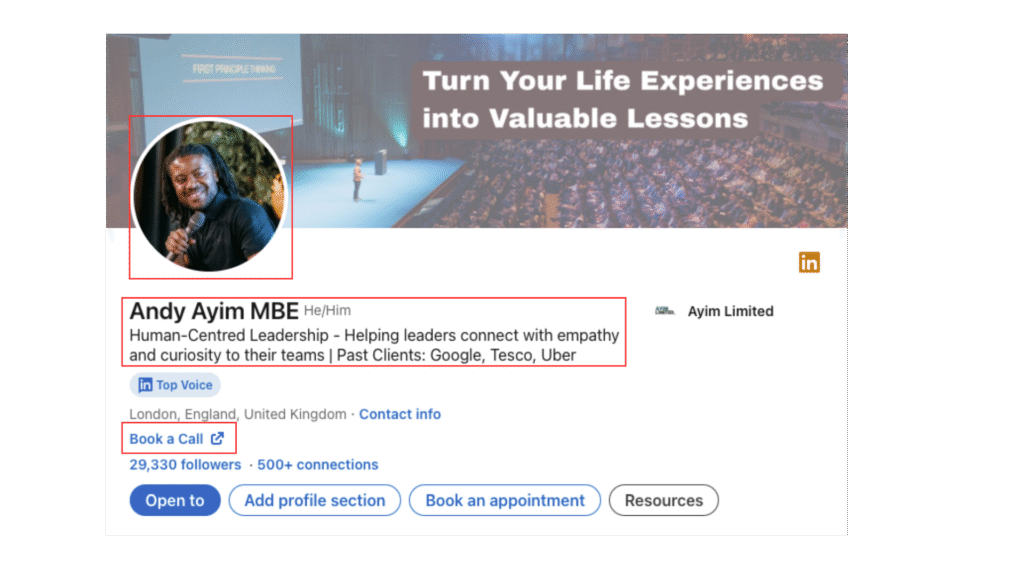
As highlighted above, you want to nail three key things to make yourself bookable.
- A clear headshot of you, real no avatar.
- A short description of what you do (this represents your brand message).
- A link to book a quick discovery call with you.
In regards to the short description, I focus on the keyword I want to be known for, just like how Brene Brown is known for vulnerability, Barack Obama is known for Hope, and Simon Sinek is known for Start with Why (purpose). Following that, I clearly and consistently describe how I am in service to my ICP. I help leaders connect with curiosity and empathy to their teams. In reality, I do much more than that, but this is what gets me in the door so I lead with this message.
I intentionally use feelings to evoke an emotional response, with ‘curiosity and empathy’ specifically listed. I want my ICP to think about their situation, read this headline and consider booking a call with me off the back of it.
I say ‘consideration’ intentionally, because to build trust and convert the ICP to book a call, I want them to experience a little of what I do and how I do it through my content. You need to post valuable content. Don’t focus on impressions, engagement or necessarily frequency. That can distract you. Here is what you need to focus on and why.
The Value of Content
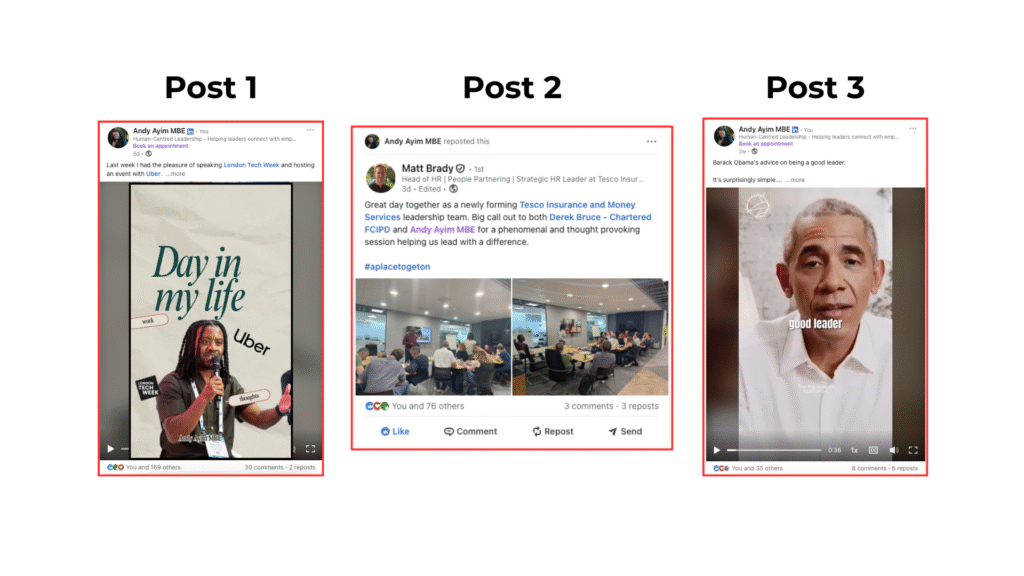
I am a big believer that AI should supplement human creativity, but sadly, it is being overused by creators on LinkedIn, which makes a lot of the editorial posts on the platform feel the same. Here are three ways I cut through the noise.
Post 1 shows a Day in the Life of Andy (me!). It gives prospects an insight into what I get up to, how I speak/ facilitate and creates some FOMO (fear of missing out). The second post is my favourite as I reposted a post from one of my clients where they share in their own words unprompted, how they found the experience I facilitated. They used words such as “phenomenal and thought-provoking.” This is great for me as prospects read this and can decide if they want an experience for their leaders that is both phenomenal and thought-provoking, then they should book a call with me. The final post shares that a global leader like Obama shares my views on what really matters in human-centred leadership. Obama is an influencer and can have a positive influence on my prospects to book a call.
Other content that I leverage on LinkedIn includes podcasts that I guest on that I know my ICP listens to such as The Everyday Leadership podcast, The CIPD podcast and The Rethink Leadership Podcast. Featuring on these podcasts helps to amplify my message to a broader audience of potential prospects and builds my authority on my topic/ message – human-centred leadership.
The goal isn’t the volume of views of your content, it’s instead about the value you are delivering, so focus on quality, not quantity here.
Creating Your Enquiry System
Big props to Alex Merry, founder of MicDrop for this one. When I joined Alex’s community, he made me painfully aware of the fact that I didn’t have an easy way for prospects to book a call with me on my LinkedIn profile. I felt a little embarrassed given how experienced I was but I was humble enough to take on such a simple but powerful lesson.
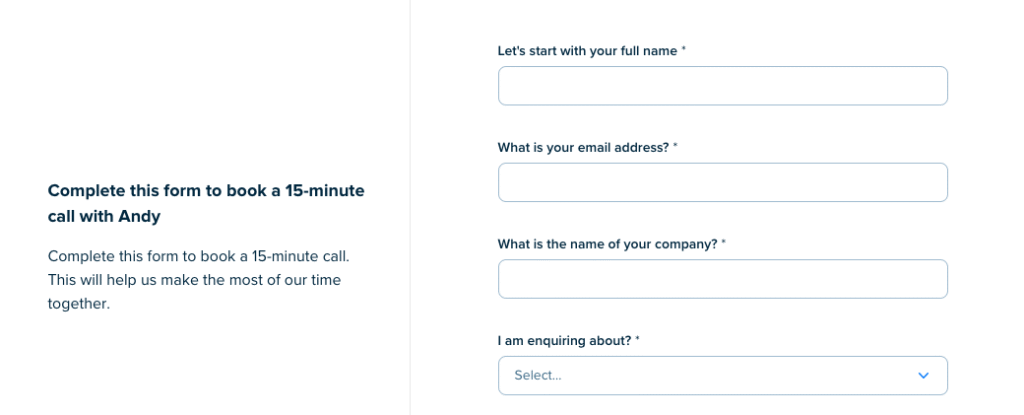
There are a number of different tools you could use for this, but I use Calendly. When someone clicks “Book a Call” on my profile, it leads them to a Calendly form (under the ‘Routing Forms’ section) before allowing them to select a time in my calendar.
To insert a link like this on your LinkedIn profile, click the pencil to the far right of your name and the ‘Edit Intro’ box will pop up. Scroll to the bottom and click ‘Add custom button’, there you can add an external link (mine is from Calendly) then write ‘Link text’, mine says “Book a Call.”
You can head to my profile to check it out and see the way I have set up my form. Feel free of course, to steal with pride and personalise it to suit your business, don’t be lazy and just copy and paste.
I had enquiries from prospects within a week of implementing this. My only tip would be to ensure you are connecting with more ICPs on LinkedIn to increase the chances of them seeing your profile and valuable content. That’s inbounding covered, let’s cover Nearbounding next as it is the most undervalued sales lever you need to be doing today!!
Nearbounding
I learned this term through working with a great sales coach Jon Onabowu, he gave language to something I had been doing but had never described in this way before. Nearbounding is the strategy of leveraging your existing network, relationships, and partners to generate leads and secure new clients. It’s about tapping into the trust and credibility you’ve already built.
How it Works
Instead of cold outreach, you ask your contacts for introductions to people who might benefit from your services. This could involve referrals from satisfied clients, partnerships with complementary businesses, or simply reaching out to people you already know who could introduce you to your ideal customer profile.
It could be as simple as sending a 60-second video to your WhatsApp contacts, saying:
“Hi, I know we may have met once or many times before, but I recently launched my leadership development business that helps leaders connect better with their teams and I recently worked with clients such as Nandos and Google. I would love to be introduced to any Heads of People, Heads of L&D or Heads of Departments you know who may value having an initial call with me.
I don’t usually do this but I believe in what I do and introductions from trusted friends go a long way. I have a short message template you can tailor and send on. Your help would be much appreciated.” Your help is much appreciated.”
Another method is to download your LinkedIn connections from the Settings on LinkedIn. Then open the file in Microsoft Excel or Google Sheets to:
- Highlight the first connections you know well.
- Highlight next the ones who work at companies you would love to work with.
- Create a short script to send to them.
Here is an example I shared with a friend I know well for over a decade and he now works at a big tech company. For this message, I used ‘indirect nearbounding’ as I didn’t ask for an introduction to my ICP. Instead, I took advantage of the social media calendar (often low budget/ free events but a great way to get in and build relationships).
I sent the message below in July, well ahead of Black History Month in the UK (October). The aim of this free 90 minute session is to get 30 emerging leaders to experience my work with two asks:
- Testimonial as feedback helps me both improve the offering and with permission, I can include the testimonial in marketing material to attract other ICPs.
- Introductions to their Heads of the Department/ HR/ L&D. Nearbounding like this is powerful as they can share first-hand experiences of my facilitation.
Sometimes, I could even get lucky and have my ICP in the room experiencing my work. I tend to offer this to only 2-3 companies as it’s promotional and free, so limiting the experience is wise.
Hi [ insert name ],
Hope you’re enjoying the spell of great weather we have had!
Excuse the professional message but it will make sense as you have a read.
It has been a while since we last caught up but great to see your career has gone from strength to strength.
In recent years I have been facilitating human-centered leadership development programs at companies such as Novartis, Google and Tesco.
As you can imagine I can count the number of Black leaders who have been in the room on one hand outside of Google.
I’m reaching out because I’m planning a special in-person workshop, “Discovering Your Leadership Edge: Own Your Narrative, Lead with Impact,” designed to empower Black emerging leaders during Black History Month in October.
I was hoping you might be able to connect me with the leader of the Black Employee Resource Group at Netflix.
If you’re able to make an introduction, I’d be very grateful. Of course, no worries if it’s not possible.
Best regards,
Andy
(my email address)
This message is emotive, personal and authentic. It makes it effortless to pass the message on to the key contact I would like to connect with. Notice too how I end the message with a no-pressure ‘opt-out’ by saying ‘no worries if it’s not possible.’ This allows the person to feel comfortable to reply no rather than ghost me.
Crowdbounding
Am I allowed to have a favourite method?
I have to confess, I LOVE crowdbounding. Why? Because it lets my ICPs experience my work firsthand—there’s no better way to show what I do than to let them see it in action. Think of it as the service-based sales version of a free trial, or what I call your “Ideal Assembly.”
Crowdbounding is the strategic approach of engaging with a curated group of your ideal prospects (ideal assembly) by speaking at targeted events, hosting niche webinars, or participating in industry roundtables. It’s about positioning yourself as an expert in front of the right audience.
Emphasis…. in front of THE RIGHT AUDIENCE of ICPs. Let’s look at an example.
Finding your Ideal Assembly
I did some research in November 2024 and found Richmond Events on Linkedin.
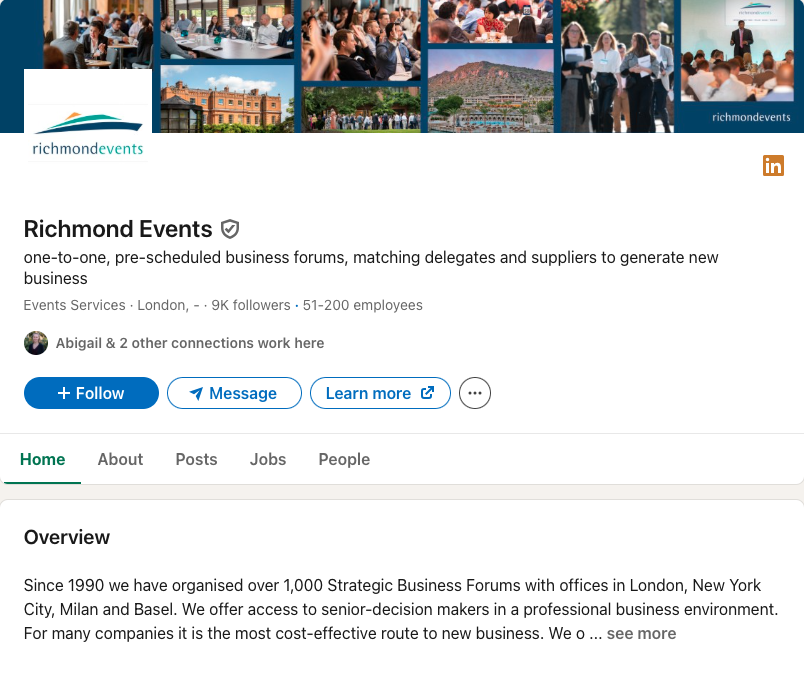
I found out they run both a London HR Forum and Learning and Development forum but I didn’t know anyone who worked there. So I clicked on ‘Message’ on their LinkedIn page above and wrote a message to position myself as a workshop facilitator as I was familiar with the formats of their events from their LinkedIn posts, mentions of their name (you can search for this) and their website.
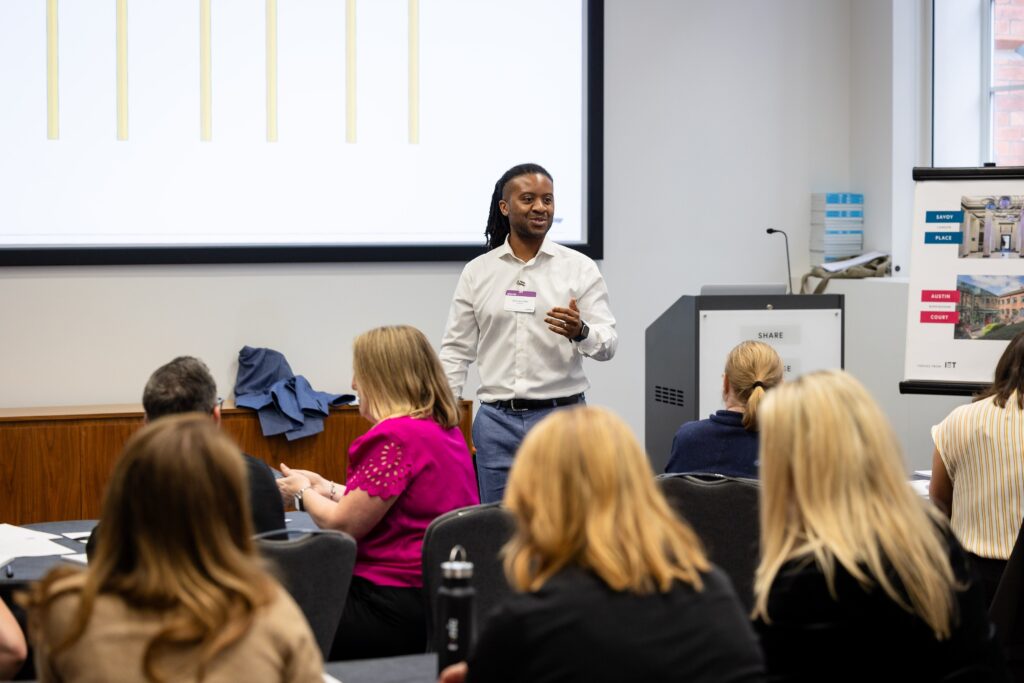
A member of their team got in touch and arranged a call. I got booked for the May 2025 L&D Spring Forum. It was a 50-minute session which was interactive, thought-provoking and fun. I received great feedback, and fortunately, the lady who booked me listened to my session, so she got to experience what I do first-hand.
Following the talk, I had a QR code which allowed attendees to receive a copy of the slides and a one-pager cheat sheet. I didn’t gate this with an email; instead, I left my business card on everyone’s seat and I connected with a personal message on LinkedIn afterwards.
You may be wondering, why would I not make participants enter an email address so that I know who downloaded my giveaways? Well, because I value much more that we are connected on LinkedIn, where I can stay front of mind, nurture an authentic connection and when the time is right, they can book a call with me. This approach converts and has led to discovery calls post the event.
I also got some great pictures from this event, which I’ve recycled into further content showing me in action.
With Crowdbounding, you identify events (online or in-person) where your ideal customers gather. By presenting valuable insights and demonstrating your expertise, you attract the attention of potential clients who are already interested in the topic.
Workshops, seminars and webinars are better than keynotes. You want to create dialogue rather than one-way communication from a stage. The closer the experience is to what it is like working with you, the better. A keynote can create space between you and your ICP, whilst a workshop is more intimate and brings you closer.
Outbounding
Outbounding is the proactive approach of reaching out to potential clients who may not be familiar with your services. It involves initiating contact through cold calls, emails, or targeted advertising. However, targeted advertising is out of scope for this guide.
You identify companies or individuals who fit your ideal customer profile and directly contact them with a personalised message highlighting how your services can solve their specific problems. With LinkedIn Premium, you can do this you don’t need LinkedIn Sales Navigator, although it can amplify your efforts.
Jon, whom I mentioned before, is an expert with cold calls. The three key things to bear in mind when cold calling are:
- Be comfortable with getting a lot of No’s.
- Be comfortable sharing how you got their number, as they may ask.
- Understand the 2-3 key challenges your ICPs typically face.
An example of a challenge my ICP could face is that they have a newly formed leadership team and they want to improve their working relationship to ensure they can collaborate well as a team.
When I do outbounding, I focus on being personal and relevant. I research the company, look up the decision-maker (usually a Head of People, L&D, or Department), and send a concise, tailored message.
Hi [Name],
I noticed your team recently [mention a relevant change, e.g., “went through a restructure” or “launched a new leadership initiative”]. I specialise in helping leadership teams connect and collaborate more effectively, especially during times of change.
If you’re open to it, I’d love to share a few ideas or run a short session for your team—no strings attached.
Let me know if you’re interested,
Andy
I keep it short, specific, and focused on their needs, not mine. Sometimes I’ll follow up with a voice note or a short video message to stand out. Most people won’t reply, and that’s okay. Outbounding is a numbers game, but when you do get a response, it’s often from someone genuinely interested in what you offer.
The key is to be persistent without being pushy, and always respectful of their time and attention. Outbounding can feel uncomfortable at first, but it’s a powerful way to build your pipeline, especially when you’re just starting out or want to break into new markets.
Conclusion: Putting It All Together
If you’ve made it this far, you now have a practical, real-world framework for selling services—one that’s been shaped by years of trial, error, and learning in the trenches. Whether you’re just starting out or looking to refine your approach, remember: there’s no single “right” way to do service-based sales. The best results come from experimenting, listening, and adapting as you go.
Start with your Ideal Customer Profile. Get crystal clear on who you want to serve and what they truly need. Use conversations—not assumptions—to validate your fit.
Then, choose the methods that play to your strengths and your market:
- Inbounding to attract and nurture warm leads through valuable content.
- Nearbounding to leverage the trust and reach of your existing network.
- Crowdbounding to showcase your expertise in front of the right audience.
- Outbounding to proactively open doors and create new opportunities.
You don’t need to do everything at once. Pick one or two methods, commit to them, and track what works. Over time, you’ll build a repeatable process that feels authentic to you and delivers real value to your clients.
Most importantly, remember that service-based sales is about relationships, not transactions. When you focus on helping, listening, and exceeding expectations, you’ll not only win more business, you’ll build a reputation that opens doors for years to come.
Now, go put your framework into action. Your next great client is out there, waiting to connect.
The best way to thank me for putting this guide together?
Make an introduction to one of my Ideal Customer Profiles, Heads of HR, Heads of Learning & Development, or Heads of Department who might benefit from a fresh perspective on leadership and team connection. 😉
If you know someone who fits the bill, I’d love to connect. And if you put any of these methods into practice, let me know how it goes—I’m always keen to hear your stories and learn together.
Thank you for reading, and here’s to your next great client!